Offside Rule Explained: A Beginner’s Guide to Football’s Most Confusing Law
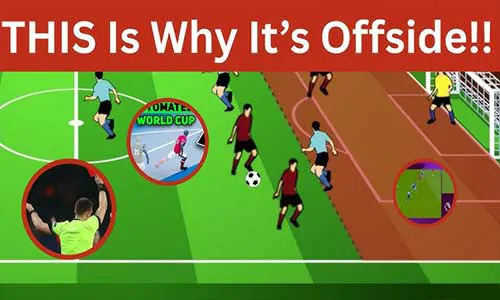
Football is undoubtedly the world’s most beautiful game, captivating billions of supporters globally. However, for newcomers, one particular regulation often acts as a major barrier to fully understanding the tactics. If you have ever found yourself bewildered by a referee’s whistle blowing right when a striker scores, you are not alone. In this comprehensive manual, you will find the Offside Rule Explained: A Beginner’s Guide to Football’s Most Confusing Law, designed specifically to help you appreciate every tactical nuance on the pitch without feeling left behind.
Indeed, grasping this fundamental law will completely transform how you watch football. Consequently, you will find yourself analyzing plays like a professional commentator rather than scratching your head in confusion. Let us break down this intricate rule step by step, using clear terms, practical scenarios, and historical context.
Table of Contents
- 1. Understanding the Basics: Offside Rule Explained: A Beginner’s Guide to Football’s Most Confusing Law
- 2. Why the Offside Rule Explained: A Beginner’s Guide to Football’s Most Confusing Law Matters
- 3. Offside Position vs. Offside Offense: Knowing the Crucial Difference
- 4. The Three Golden Conditions of an Offside Position
- 5. Defining Active Play: Offside Rule Explained: A Beginner’s Guide to Football’s Most Confusing Law
- 6. Key Exceptions to the Offside Rule
- 7. The Role of Officials and VAR in Modern Offside Calls
- 8. Quick Reference: Offside Rules at a Glance
- 9. Frequently Asked Questions (FAQ)
- 10. Conclusion and Call to Action
1. Understanding the Basics: Offside Rule Explained: A Beginner’s Guide to Football’s Most Confusing Law
To begin our journey, we must first establish what the offside rule is in its simplest form. According to the International Football Association Board (IFAB), Law 11 governs offside play. The rule was fundamentally designed to prevent “goal-hanging”—a cheap tactic where an attacker simply waits near the opponent’s goal to receive long passes.
Furthermore, without this rule, the strategic depth of modern football would completely disintegrate. Teams would no longer need to pass fluidly through midfield. Instead, matches would devolve into long-ball scrambles, ruining the beautiful flow of tactical build-ups. Therefore, the rule serves as the structural backbone of fair, competitive football.
However, understanding this law requires looking at the positions of the players at a very specific moment. Specifically, the exact millisecond the ball is passed by a teammate, rather than when the receiving player actually touches the ball. This distinction is where most beginners struggle, yet it is the most critical element of the entire rule.
2. Why the Offside Rule Explained: A Beginner’s Guide to Football’s Most Confusing Law Matters
For any casual spectator, understanding this concept is the gateway to appreciating defensive tactics. For instance, when you see a defensive line suddenly step forward in unison, they are executing what is known as an “offside trap.” By doing so, they deliberately leave opposing attackers in an offside position right before a pass is made.
Additionally, knowing the rule allows you to understand why referees make seemingly controversial calls. In addition, it helps you appreciate the immense pressure placed on assistant referees. These officials must keep their eyes on both the passer in midfield and the defensive line deep down the pitch simultaneously.
Ultimately, this knowledge enhances your enjoyment of every match. Instead of feeling frustrated by sudden stops in play, you will immediately recognize the tactical movements that triggered the referee’s whistle. Consequently, you will feel much more connected to the strategic chessboard that is modern football.
3. Offside Position vs. Offside Offense: Knowing the Crucial Difference
One of the most common misconceptions among beginners is that simply standing in an offside position is an immediate violation. On the contrary, it is not an offense in itself to exist in an offside position. An attacker can stand near the opponent’s goalkeeper all day without committing an infraction, provided they are not involved in active play.
Specifically, a player only commits an offside offense if they become actively involved in the phase of play while occupying that offside position. If the ball is passed to a completely different player on the opposite side of the pitch, the offside player is ignored by the referee. Thus, understanding this difference is key to demystifying modern match dynamics.
To help illustrate this, we must examine what constitutes the physical “offside position” versus the “offside offense.” Let us look at the precise conditions that linesmen look for during a fast-paced game.
4. The Three Golden Conditions of an Offside Position
An attacker is considered to be in an offside position if they meet three specific criteria simultaneously at the exact moment the ball is played by a teammate. These criteria are:
- The Halfway Line: The player must be inside the opponent’s half of the pitch. A player can never be offside if they are in their own defensive half.
- Distance to Goal: The player must be closer to the opponent’s goal line than the ball itself. If the attacker is behind the ball when it is passed, they are completely safe.
- The Second-Last Opponent: The player must be closer to the opponent’s goal line than the “second-last opponent.” In 99% of defensive setups, the goalkeeper is the last opponent, meaning the “second-last opponent” is the final outfield defender.
Furthermore, it is important to clarify which body parts count when determining an offside position. According to official IFAB regulations, any part of the head, torso, or legs that can legally score a goal is considered. Conversely, the hands and arms of both defenders and attackers are completely excluded from offside calculations.
Consequently, if a striker’s hand is slightly ahead of the last defender, they are still onside. However, if their knee or shoulder is even a millimeter ahead of the defender’s deepest legal body part, they are technically in an offside position.
5. Defining Active Play: Offside Rule Explained: A Beginner’s Guide to Football’s Most Confusing Law
Now that we have established what constitutes an offside position, let us analyze how it transforms into an actual offense. According to the Offside Rule Explained: A Beginner’s Guide to Football’s Most Confusing Law, a player in an offside position is only penalized if they become involved in “active play” in one of three ways:
A. Interfering with Play
This is the most straightforward scenario. It occurs when an attacker physically touches or plays the ball that was passed or touched by a teammate. If you are standing in an offside position and the ball strikes your boot, the whistle will blow immediately.
B. Interfering with an Opponent
This scenario is slightly more subjective and often leads to heated debates. A player interferes with an opponent by preventing them from playing the ball, blocking their line of sight, or making a physical gesture that clearly distracts or challenges a defender or goalkeeper. Even if the offside attacker does not touch the ball, they are penalized if their presence directly hinders the defense.
C. Gaining an Advantage
This happens when a player plays the ball after it has rebounded off the goalpost, the crossbar, or an opposing player. For instance, if a striker shoots, and their teammate—who was standing in an offside position—taps in the rebound, the goal is disallowed. The teammate gained an unfair advantage by being in that illegal position initially.
6. Key Exceptions to the Offside Rule
To make matters even more interesting, there are three very specific set-piece situations where the offside rule is temporarily suspended. No matter where an attacker stands, they can never be called offside directly from:
- A Throw-in: If a player receives a direct throw-in from a teammate, they can stand right next to the opponent’s goal and remain perfectly legal.
- A Corner Kick: Because a corner kick is taken from the very corner of the opponent’s goal line, the ball is naturally ahead of all attackers, making an offside position mathematically impossible at the moment of the kick.
- A Goal Kick: A direct pass from a goal kick can find an attacker deep in the opponent’s half without any risk of an offside penalty.
In addition to these exceptions, a player cannot be penalized for offside if they receive the ball directly from an opponent’s deliberate play. For example, if a defender intentionally passes the ball backward to their goalkeeper but accidentally finds an opposing striker standing deep behind the defense, the striker is completely onside because the defender deliberately initiated the play.
7. The Role of Officials and VAR in Modern Offside Calls
Traditionally, offside decisions relied entirely on the sharp eyes of the two Assistant Referees running along the touchlines. These officials must maintain a perfect line of sight with the second-last defender while keeping track of the exact millisecond a midfielder releases a pass. Needless to say, it is one of the most difficult jobs in professional sports.
However, the modern era has introduced the Video Assistant Referee (VAR) to assist with these tight calls. Under FIFA guidelines, VAR utilizes high-definition cameras and calibrated virtual lines to assess offside decisions during goal-scoring sequences. You can learn more about official tournament applications on the Official FIFA Website.
Furthermore, many major competitions have now implemented Semi-Automated Offside Technology (SAOT). This system uses multiple specialized cameras to track players’ limbs and utilizes a sensor inside the ball to detect the exact moment of impact. Consequently, offside decisions are now resolved with incredible mathematical precision, reducing human error to an absolute minimum.
8. Quick Reference: Offside Rules at a Glance
To consolidate what you have learned, review this quick reference table summarizing key scenarios on the pitch:
| Scenario on the Pitch | Offside Call? | Reason / Explanation |
|---|---|---|
| Attacker in opponent’s half behind the ball when passed. | ONSIDE | You can never be offside if you are behind the ball. |
| Attacker receives ball directly from a corner kick. | ONSIDE | Corner kicks are completely exempt from the offside law. |
| Attacker is level with the second-last defender. | ONSIDE | Being perfectly level with the defender does not constitute an offside position. |
| Attacker stands offside, but teammate passes to an onside winger. | ONSIDE | The offside player was not involved in active play. |
| Defender intentionally passes back, but attacker intercepts. | ONSIDE | Offside does not apply when receiving a deliberate play from an opponent. |
| Attacker stands offside and blocks goalkeeper’s vision of a shot. | OFFSIDE | This is a violation due to interfering with an opponent. |
9. Frequently Asked Questions (FAQ)
To further clarify any lingering doubts, here are answers to the most common questions regarding this famous football rule:
Q1: Can a player be offside in their own half of the pitch?
No, a player cannot be penalized for offside while standing in their own half of the field. The offside rule only applies once the attacker crosses the halfway line into the opponent’s territory.
Q2: Does the goalkeeper count as one of the two opponents?
Yes, absolutely. The rule states there must be “two opponents” between the attacker and the goal line. In almost all defensive structures, the goalkeeper is the deepest player, making them the “last opponent,” while the final defender acts as the “second-last opponent.”
Q3: What happens if the goalkeeper rushes up the pitch?
If the goalkeeper leaves their net to join an attack or defend a set-piece, they are no longer the deepest player. Consequently, the second-last opponent rule still applies. In this rare scenario, there must be two outfield defenders between the attacker and the goal line for the attacker to remain onside.
Q4: Why isn’t a throw-in subject to the offside rule?
The exclusion of throw-ins is designed to keep the game flowing fluidly. It encourages teams to restart play quickly and prevents defensive blocks from squeezing the pitch too tightly during restarts near the touchline.
Q5: What is the “offside trap” and how does it work?
The offside trap is a coordinated defensive tactic where defenders quickly run forward in a straight line right before an opponent passes the ball. This leaves the opposing strikers stranded behind the defensive line in an offside position, forcing the referee to blow the whistle.
Q6: Does VAR make offside decisions 100% accurate?
While VAR and Semi-Automated Offside Technology have significantly increased the accuracy of offside decisions, slight margins of error can still exist regarding the exact millisecond the ball is kicked. However, the system has successfully eliminated egregious errors from the professional game.
10. Conclusion and Call to Action
In summary, the offside rule is not nearly as incomprehensible as it first appears. By remembering that offside is determined the instant the ball is passed—and that a player must be actively involved in the play to be penalized—you have mastered the core logic of Law 11. Now, you can confidently watch any match with a deep tactical understanding of the action.
Ultimately, this knowledge elevates your experience from a casual viewer to a true fan of the sport. The next time you watch a game, pay close attention to the defensive line and the timing of the strikers’ runs. You will quickly see how this simple yet profound rule shapes the entire landscape of modern football tactics.
What is your take on how VAR handles tight offside calls? Do you prefer the traditional assistant referee approach, or do you appreciate the high-tech precision of modern systems? Leave a comment below and share this article with a friend who is still trying to figure out the beautiful game!