Football Formations Guide: From 4-4-2 to Today’s Tactical Systems
Football is a beautiful, constantly evolving game of chess played on a grass pitch. Over the decades, managers have continuously sought the perfect system to outwit their opponents, leading to a rich history of tactical innovation. Whether you are an aspiring coach, a passionate fan, or an analyst, understanding these shapes is essential. This comprehensive Football Formations Guide: From 4-4-2 to Today’s Tactical Systems will walk you through the evolution, mechanics, strengths, and weaknesses of football’s most iconic and modern setups.
Table of Contents
- Why Every Fan Needs a Football Formations Guide: From 4-4-2 to Today’s Tactical Systems
- The Foundation: The Traditional Flat 4-4-2
- The Evolution of Possession: The Dynamic 4-3-3
- The Modern Standard: The Versatile 4-2-3-1
- The Resurgence of the Back Three: 3-5-2 and 3-4-3
- Mastering the Board with the Football Formations Guide: From 4-4-2 to Today’s Tactical Systems
- Tactical Systems Comparison Table
- How to Choose the Right Setup: Our Football Formations Guide: From 4-4-2 to Today’s Tactical Systems
- Conclusion and Tactical Takeaways
- Frequently Asked Questions (FAQ)
Why Every Fan Needs a Football Formations Guide: From 4-4-2 to Today’s Tactical Systems
At its core, a football formation is the structural starting point of a team’s strategy. However, modern football is highly fluid. Players rarely remain fixed in their nominal positions; instead, they shift dynamically depending on whether their team has possession of the ball. Consequently, a team might defend in a compact 4-4-2 but transition into an expansive 3-2-4-1 when attacking.
Understanding these tactical nuances allows you to appreciate the game on a deeper level. By analyzing how space is created, exploited, and defended, you can begin to see the hidden battles happening away from the ball. Therefore, this guide serves as your roadmap to deciphering the complex strategic decisions made by elite coaches on the touchline.
Historically, tactics have shifted from highly attacking, top-heavy formations like the 1930s “WM” setup to highly structured, defensive systems. Today, we witness a hybrid era where flexibility, positional rotation, and verticality reign supreme. Let us begin our tactical journey by looking at the foundation of modern team structures: the classic 4-4-2.
The Foundation: The Traditional Flat 4-4-2
For decades, the flat 4-4-2 was the undisputed king of football formations, particularly in British football. This system relies on two banks of four players and a strike partnership up front. In this setup, balance, simplicity, and clear positional responsibilities are the primary objectives.
In a traditional 4-4-2, the wingers are expected to provide width and deliver crosses into the box. Meanwhile, the two central midfielders have distinct roles: typically, one acts as a defensive destroyer, while the other drives forward to support the strikers. Upfront, teams often utilize a “big man, small man” partnership, where a physical target man wins aerial duels to set up a quick, agile second striker.
The Strengths of the Flat 4-4-2
- Defensive Solidity: Having two clear banks of four makes it incredibly difficult for opponents to play through the lines, especially when the team defends in a low block.
- Excellent Pitch Coverage: The natural symmetry of the formation ensures that all areas of the pitch are evenly occupied, minimizing gaps.
- Simplicity: Players understand their roles easily, which makes the system highly disciplined and easy to implement.
The Weaknesses of the Flat 4-4-2
- Midfield Overload: Because most modern teams play with three central midfielders, a 4-4-2 can easily find itself outnumbered in the center of the park.
- Predictability: The rigid structure can make attacking transitions somewhat predictable, relying heavily on wing play and crosses.
- Space Between the Lines: If the midfield bank fails to drop back quickly, clever attacking midfielders can easily exploit the space behind them.
While the flat 4-4-2 has fallen out of favor as a primary attacking system among elite clubs, it remains an incredibly popular defensive shape. For instance, teams often shift into a compact 4-4-2 when out of possession to frustrate opponents and close down passing lanes.
The Evolution of Possession: The Dynamic 4-3-3
As managers sought ways to dominate midfield possession, the 4-3-3 formation emerged as the perfect solution. Popularized by Rinus Michels’ “Total Football” and perfected by Johan Cruyff, this system prioritizes passing triangles, positional rotation, and high pressing. For a deeper analysis of historical tactical evolutions, you can explore the technical resources on FIFA’s Official Website.
In a 4-3-3, the midfield trio is the engine room. Usually, it consists of a deep-lying defensive playmaker (the single pivot) and two creative central midfielders (the “8s”). Upfront, two wide wingers flank a central striker. However, in modern variations, these wingers often cut inside onto their stronger feet, acting as inside forwards while the full-backs overlap to provide width.
Why the 4-3-3 Dominates Modern Possession
The primary advantage of the 4-3-3 is the natural creation of passing triangles. No matter where a player is on the pitch, they almost always have at least two passing options. Furthermore, this structure allows for a highly effective counter-press. If the team loses the ball in the attacking third, they are already positioned to swarm the opponent and win it back immediately.
In addition, the 4-3-3 is highly adaptable. Depending on the manager’s philosophy, it can be played with a traditional central striker or a “False Nine.” The False Nine drops deep into the midfield, dragging opposing center-backs out of position and opening up massive spaces for inverted wingers to exploit.
Key Tactical Challenges of the 4-3-3
- Vulnerability on the Counter: Because the full-backs regularly push high up the pitch to support the attack, they often leave massive spaces behind them for opponents to exploit during transitions.
- Physical Demands on the Single Pivot: The defensive midfielder must possess exceptional spatial awareness, stamina, and tactical intelligence to shield the backline alone.
- Requirement for Highly Technical Players: This system fails if the players lack the passing range, vision, and technical ability to keep the ball in tight spaces.
The Modern Standard: The Versatile 4-2-3-1
During the late 2000s and 2010s, the 4-2-3-1 became the go-to tactical blueprint for elite European clubs. This formation offers a perfect bridge between the defensive structure of the 4-4-2 and the possession-oriented fluidity of the 4-3-3. It utilizes a “double pivot” (two defensive midfielders) behind an attacking trio and a lone striker.
The double pivot is the cornerstone of this system. One midfielder typically acts as a ball-winner, while the other is a deep-lying playmaker who orchestrates transitions. Ahead of them, the central attacking midfielder (the traditional Number 10) acts as the creative mastermind, threading key passes to the wingers and the striker.
The Strengths of the 4-2-3-1
- Exceptional Defensive Security: The double pivot provides a robust shield in front of the center-backs, making it incredibly difficult for opponents to counter-attack.
- Creative Freedom for the Front Four: With two defensive midfielders holding the fort, the attacking midfielders and striker have the license to rotate and create chances.
- Flexibility in Transition: The formation easily transitions into a defensive 4-4-1-1 or an attacking 4-2-4, making it highly adaptable to different game states.
The Weaknesses of the 4-2-3-1
- Isolation of the Lone Striker: If the attacking midfielders are pinned back by the opponent’s defense, the striker can easily become isolated and starved of service.
- Over-reliance on the Number 10: If the opponent successfully marks the central attacking midfielder out of the game, the team’s creative output can drop drastically.
- Fatigue of the Wide Midfielders: The wingers must track back constantly to help their full-backs, requiring immense physical endurance.
The Resurgence of the Back Three: 3-5-2 and 3-4-3
Tactical trends are cyclical, and the resurgence of back-three systems over the past decade is a testament to this fact. Once dismissed as overly defensive, formations like the 3-5-2 and 3-4-3 have been completely redefined by modern tactical innovations. Managers like Antonio Conte and Gian Piero Gasperini have shown that a back three can actually be incredibly aggressive and attacking.
In these systems, the wing-backs are the most critical players. They are responsible for patrolling the entire flank, acting as defenders when out of possession and as auxiliary wingers when attacking. For a highly detailed visual and tactical breakdown of wing-back systems, we recommend checking out The Coaches’ Voice, an industry-leading resource for football coaching analysis.
The Strategic Mechanics of the 3-5-2
The 3-5-2 utilizes three central defenders, two wing-backs, three central midfielders, and two strikers. This setup allows teams to dominate the central areas of the pitch while maintaining defensive numbers. When defending, the wing-backs drop deep to create a highly compact five-man defense. Conversely, during possession, they push forward to create numerical overloads in the final third.
The Aggressive Nature of the 3-4-3
In contrast to the 3-5-2, the 3-4-3 swaps a central midfielder for an extra attacker, creating a formidable front three. This formation is ideal for teams that want to press high up the pitch. The three forwards can match up directly against the opponent’s backline, forcing turnovers in dangerous areas. Additionally, the presence of three center-backs allows the team to sustain pressure without fearing quick counter-attacks.
- Pro: Superb width and overlapping options provided by the wing-backs.
- Pro: Built-in numerical advantage against two-striker systems.
- Con: Highly demanding physically on the wing-backs, who must run constantly.
- Con: If the wing-backs are pinned deep, the formation quickly mutates into an inactive, defensive 5-3-2 or 5-4-1.
Mastering the Board with the Football Formations Guide: From 4-4-2 to Today’s Tactical Systems
In contemporary elite football, standard numerical formations no longer paint the full picture. Today’s tactical systems are defined by hybrid structures and positional play (Juego de Posición). Managers like Pep Guardiola, Mikel Arteta, and Roberto De Zerbi design systems where players change their positions entirely depending on the phase of play.
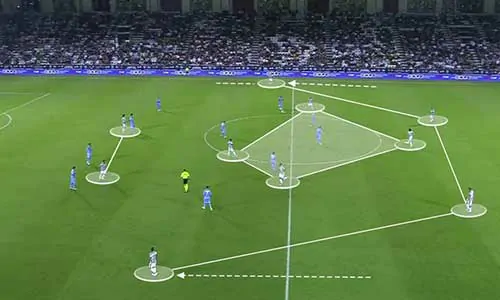
One of the most prominent examples of this is the 3-2-4-1 system used during possession. To achieve this shape, a nominal full-back or center-back (such as John Stones or Trent Alexander-Arnold) will “invert” and step into the midfield during build-up play. Consequently, the team transitions from a standard 4-3-3 out of possession into a highly dominant 3-2-4-1 in possession.
The Concept of the “Box Midfield”
By inverting a full-back, teams create a “box” in the center of the pitch, usually consisting of two deep playmakers and two advanced attacking midfielders (two “10s”). This tactical setup offers several major benefits:
- Overwhelming Central Overloads: Most opponents cannot cope with four central midfielders, allowing the attacking team to control the tempo of the game with ease.
- Rest Defense: Having a solid block of five players (three defenders and two holding midfielders) positioned centrally makes the team incredibly secure against counter-attacks.
- Isolation of Elite Wingers: By crowding the center of the pitch, opponents are forced to compress their defense, leaving the wide wingers in one-on-one situations with opposing full-backs.
Therefore, when analyzing modern matches, it is crucial not to get bogged down by the team sheet. Instead, focus on how the team’s shape morphs in different phases of play. This dynamic fluidity is the true hallmark of today’s tactical landscape.
Tactical Systems Comparison Table
To help you synthesize these different systems, we have created a quick reference table summarizing the key aspects of the most prominent football formations discussed in this guide.
4-4-2
4-3-3
4-2-3-1
3-5-2
3-2-4-1 (Hybrid)
| Formation | Primary Style | Key Strengths | Core Weaknesses | Famous Example |
|---|---|---|---|---|
| Direct / Defensive Block | Exceptional structure, simplicity, defensive depth. | Can be easily overrun in central midfield. | Arrigo Sacchi’s AC Milan / Leicester City (2015/16) | |
| Possession / High Press | Natural passing triangles, excellent wing play, high press. | Vulnerable to counter-attacks in wide areas. | Pep Guardiola’s Barcelona / Jurgen Klopp’s Liverpool | |
| Balanced / Transition | Strong defensive shield, creative freedom for attackers. | Lone striker can easily become isolated. | Jose Mourinho’s Real Madrid / Jupp Heynckes’ Bayern Munich | |
| Counter-Attacking / Wing-back centric | Numerical superiority in midfield, excellent width. | Extreme physical demands on the wing-backs. | Antonio Conte’s Inter Milan / Juventus | |
| Positional Play / Central Overloads | Complete midfield dominance, elite counter-press. | Vulnerable to direct, fast counter-attacks behind the back three. | Pep Guardiola’s Manchester City (2022/23) |
How to Choose the Right Setup: Our Football Formations Guide: From 4-4-2 to Today’s Tactical Systems
If you are a coach or creating a tactical model for your team, choosing the right formation is not about picking the trendiest system. Instead, it must be dictated by your players’ unique profiles, your opponent’s weaknesses, and your overall footballing philosophy. A formation should always empower your best players to succeed.
For example, if you have highly energetic full-backs who love to run but lack elite creative wingers, a back-three system like the 3-5-2 is highly logical. On the other hand, if your team boasts a world-class creative midfielder who struggles with defensive duties, a 4-2-3-1 provides the perfect double-pivot safety net to unleash their offensive creativity.
Furthermore, tactical flexibility is crucial. The best modern managers do not stick rigidly to a single system. Instead, they prepare their teams to transition seamlessly between multiple structures mid-game to exploit specific weaknesses in the opponent’s defensive block. Thus, mastering these tactical concepts is a continuous process of observation, analysis, and adaptation.
Conclusion and Tactical Takeaways
In summary, the tactical journey of football is an ongoing story of action and reaction. The dominance of the classic flat 4-4-2 paved the way for the possession-heavy 4-3-3, which in turn inspired the balanced 4-2-3-1 and the modern revival of back-three and hybrid structures. No system is inherently superior; instead, its success depends entirely on implementation, player profiles, and execution.
As you watch your next match, try to identify the team shapes both in and out of possession. Observe how full-backs invert, how midfielders rotate, and how spaces are exploited. Tactics are what makes football the ultimate thinking man’s game.
What is your favorite tactical system? Do you prefer the defensive solidity of a structured block, or the chaotic beauty of high-pressing possession football? Let us know your thoughts in the comments below, and don’t forget to share this tactical guide with your fellow football fans!
Frequently Asked Questions (FAQ)
What is the most popular formation in modern football?
Currently, the 4-3-3 and the 4-2-3-1 are the most widely used formations at the elite level. However, many of these teams transition into hybrid shapes, such as a 3-2-4-1, when they have possession of the ball.
Why did teams stop playing the flat 4-4-2?
Teams largely moved away from the flat 4-4-2 because it was easily overrun in central midfield by teams playing with three central midfielders (such as in a 4-3-3). Additionally, the modern game demands more fluid positional rotation than a rigid 4-4-2 typically allows.
What is an inverted full-back?
An inverted full-back is a defender who moves from their wide defensive position into the central midfield when their team is in possession. This tactical movement creates a numerical overload in midfield and helps control the tempo of the match.
What is the difference between a wing-back and a full-back?
A full-back plays in a traditional defensive back four and primarily focuses on defending wide areas, though they can join the attack. A wing-back plays in a back three (or five) system, occupies the entire flank alone, and is expected to contribute heavily to both defense and attack.
Can a formation change during a match?
Yes, absolutely. Modern football teams regularly defend in one formation (e.g., a compact 4-4-2) and attack in another (e.g., an expansive 3-2-4-1) depending on who has possession of the ball.
What does a “False Nine” do?
A False Nine is a striker who regularly drops deep into the midfield space instead of staying on the last line of defense. This movement pulls opposing center-backs out of position, creating space for quick wingers to exploit behind them.