FIFA World Cup 2026 Location and Viewing Guide
The global football community is buzzing with excitement as the biggest sporting event on Earth takes center stage. This comprehensive FIFA World Cup 2026 Location and Viewing Guide is designed to provide you with everything you need to know about the host nations, match locations, and where to catch the action live from any corner of the globe.
For the first time in history, three nations are co-hosting the tournament: the United States, Canada, and Mexico. Consequently, navigating the matchdays can be a massive challenge for passionate fans. By using this FIFA World Cup 2026 Location and Viewing Guide, you can seamlessly navigate the schedules, discover host venues, and unlock the absolute best streaming channels available today.
Table of Contents
- A Historic Tournament: Overview of the 2026 FIFA World Cup
- The 16 Host Cities and Stadiums Across North America
- How to Watch: Global TV Broadcasters and Channels
- Streaming the Matches Online Without Cable
- Key Dates and Match Schedule Details
- Matchday Travel and Ticketing Tips
- Conclusion and Final Thoughts
- Frequently Asked Questions (FAQ)
A Historic Tournament: Overview of the 2026 FIFA World Cup
The 2026 iteration marks a massive milestone in football history. This tournament is the very first to feature an expanded 48-team format, a dramatic increase from the traditional 32-team setup. As a result, a staggering total of 104 matches will be played over 39 days of thrilling action.
Moreover, the tournament returns to its classic Northern Hemisphere summer slot, running from June 11 to July 19, 2026. This decision ensures optimal weather conditions and allows millions of international tourists to travel easily across North America. To accommodate this massive scale, the co-hosts have upgraded their infrastructure and stadiums to elite specifications.
An Essential FIFA World Cup 2026 Location and Viewing Guide to the New Format
With 48 teams competing, the group stage features twelve groups of four teams each. The top two teams from each group, alongside the eight best third-placed teams, will advance to a brand-new Round of 32 knockout stage. Consequently, having a reliable FIFA World Cup 2026 Location and Viewing Guide becomes vital to keep track of this incredibly dynamic and fast-paced tournament.
Furthermore, the physical distance between the three host countries creates unique scheduling dynamics. Teams and spectators will travel thousands of miles between coastal metropolises and high-altitude arenas. To minimize travel fatigue, FIFA has divided the host cities into three regional zones: East, Central, and West.
The 16 Host Cities and Stadiums Across North America
Matches are being played across 16 world-class venues. The United States boasts 11 host cities, Mexico has 3, and Canada features 2. Each of these stadiums offers state-of-the-art technology, high-end hospitality, and massive seating capacities to elevate the spectator experience.
Specifically, iconic landmarks like Estadio Azteca in Mexico City are making history. Azteca is the first stadium to host matches in three separate World Cup editions (1970, 1986, and 2026). Meanwhile, modern marvels like SoFi Stadium in Los Angeles and AT&T Stadium in Dallas provide breathtaking architecture and giant, immersive video boards.
Host Venues Breakdown: FIFA World Cup 2026 Location and Viewing Guide
To make your planning easier, this FIFA World Cup 2026 Location and Viewing Guide breaks down the host cities, stadium names, and their respective seating capacities below.
| Host Country | Host City | Stadium Name (FIFA Official) | Seating Capacity |
|---|---|---|---|
| Canada | Toronto | Toronto Stadium (BMO Field) | 45,000 |
| Canada | Vancouver | BC Place (Vancouver Stadium) | 54,000 |
| Mexico | Guadalajara | Estadio Guadalajara (Akron) | 48,000 |
| Mexico | Mexico City | Estadio Azteca | 83,000 |
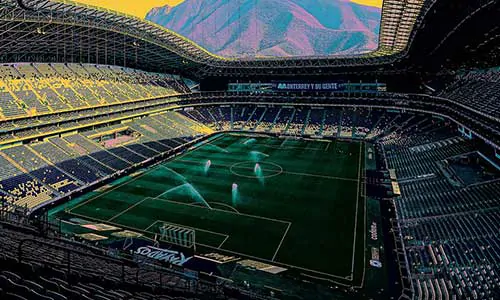
| Mexico | Monterrey | Estadio Monterrey (BBVA) | 53,500 |
| United States | Atlanta | Atlanta Stadium (Mercedes-Benz) | 71,000 |
| United States | Boston | Boston Stadium (Gillette Stadium) | 65,800 |
| United States | Dallas | Dallas Stadium (AT&T Stadium) | 80,000 |
| United States | Houston | Houston Stadium (NRG Stadium) | 72,000 |
| United States | Kansas City | Kansas City Stadium (Arrowhead) | 76,400 |
| United States | Los Angeles | Los Angeles Stadium (SoFi) | 70,000 |
| United States | Miami | Miami Stadium (Hard Rock Stadium) | 64,700 |
| United States | New York / New Jersey | New York New Jersey Stadium (MetLife) | 82,500 |
| United States | Philadelphia | Philadelphia Stadium (Lincoln Financial) | 69,700 |
| United States | San Francisco Bay Area | Bay Area Stadium (Levi’s Stadium) | 68,500 |
| United States | Seattle | Seattle Stadium (Lumen Field) | 69,000 |
Whether you are traveling to the US, Mexico, or Canada, this FIFA World Cup 2026 Location and Viewing Guide simplifies your matchday logistics. Please note that several venues will use temporary pitch installations to ensure natural grass surfaces. This ensures that the playing field meets the strict regulatory standards demanded by international football teams.
In addition, Dallas Stadium is a central focal point of this tournament. Not only does it host a record nine matches, but it also serves as the host location for the International Broadcast Center (IBC). Consequently, this FIFA World Cup 2026 Location and Viewing Guide recommends focusing your travel plans around Central hubs if you want to be at the heart of the media buzz.
How to Watch: Global TV Broadcasters and Channels
For fans who cannot attend the games in person, securing high-quality broadcast feeds is crucial. Because FIFA sells broadcasting rights directly to regional networks, the specific channel you need to watch depends heavily on your geographic location. Fortunately, major international networks have dedicated massive resources to bring the action straight to your screen.
In the United States, English-language broadcast rights are held exclusively by FOX Sports. FOX will air 70 matches on its main network channel, while its sister channel, FS1, will broadcast the remaining 34 matches. For Spanish speakers in the US, NBCUniversal holds the rights, airing matches across Telemundo and Universo.
Global TV Broadcasters: FIFA World Cup 2026 Location and Viewing Guide
Furthermore, our FIFA World Cup 2026 Location and Viewing Guide details how to access these networks. If you live in Canada, Bell Media networks TSN, CTV, and RDS will handle the coverage. TSN is scheduled to air all 104 matches, whereas CTV will broadcast marquee games during prime-time hours.
In contrast, viewers based in the United Kingdom can watch the entire tournament completely free of charge. The BBC and ITV will share the terrestrial broadcasting rights, making matches accessible on BBC One, BBC Two, ITV1, and ITV4. This terrestrial agreement ensures that millions of passionate UK fans can follow the matches without requiring a paid subscription.
On the other hand, this FIFA World Cup 2026 Location and Viewing Guide highlights free options like SBS in Australia. SBS and its dedicated digital platform, SBS On Demand, have acquired the exclusive rights for Australian soccer fans. For viewers in Mexico, TelevisaUnivision and TV Azteca will provide comprehensive national coverage of the home matches and key knockout stages.
Streaming the Matches Online Without Cable
If you have cut the cord, there are plenty of digital streaming services that let you watch every live match on your favorite devices. From mobile phones and tablets to smart TVs, modern streaming makes following your team incredibly convenient. However, it is essential to prepare your accounts in advance to avoid last-minute subscription issues.
In the United States, popular live TV streaming services offer seamless access to FOX and FS1. Services such as Fubo TV, YouTube TV, Hulu + Live TV, and DirecTV Stream include these sports channels in their basic packages. Additionally, most of these platforms offer free trials for new customers, which can be useful during the early group stages.
Online Cord-Cutting: FIFA World Cup 2026 Location and Viewing Guide
Moreover, this FIFA World Cup 2026 Location and Viewing Guide lists top cord-cutting services and their Spanish-language counterparts. If you prefer to stream in Spanish, Peacock Premium is your best option. NBC’s streaming platform will host every Spanish broadcast, making it highly affordable for soccer fans on a budget.
For Canadian streaming enthusiasts, TSN+ and the CTV app provide direct-to-consumer digital passes. Meanwhile, UK viewers can use free digital platforms like BBC iPlayer and ITVX. To ensure a buffering-free experience, make sure your internet connection meets the minimum recommended speed of 25 Mbps for 4K streaming.
Consequently, this FIFA World Cup 2026 Location and Viewing Guide suggests using a high-quality, secure VPN like Proton VPN or NordVPN if you are traveling abroad. Using a VPN allows you to legally log into your home streaming accounts, bypassing regional geoblocks so you can hear commentary in your native language.
Key Dates and Match Schedule Details
Keeping track of 104 matches requires a clear, organized schedule. The tournament is meticulously structured to prevent matches from overlapping too heavily during the knockout phases. The opening match of the tournament kicks off on June 11, 2026, at the legendary Estadio Azteca in Mexico City.
Following the opening match, Canada will host its first-ever men’s World Cup game in Toronto on June 12, 2026. On the very same day, the United States men’s national team (USMNT) will play their inaugural match in Los Angeles. This staggered opening week ensures that all three host nations receive maximum global spotlight.
Tournament Timeline: FIFA World Cup 2026 Location and Viewing Guide
In addition, this FIFA World Cup 2026 Location and Viewing Guide outlines the exact timeline of the different stages. This roadmap ensures that you do not miss the intense elimination matches as the field narrows from 48 to the final two teams.
- Group Stage: June 11 – June 27, 2026 (Multiple daily matches across all time zones)
- Round of 32: June 28 – July 3, 2026 (The brand-new single-elimination phase)
- Round of 16: July 4 – July 7, 2026 (Where the pressure intensifies significantly)
- Quarter-Finals: July 9 – July 11, 2026 (Hosted in Boston, Los Angeles, Miami, and Kansas City)
- Semi-Finals: July 14 – July 15, 2026 (Taking place in Atlanta and Dallas)
- Third-Place Play-off: July 18, 2026 (Hosted in Miami)
- The World Cup Final: July 19, 2026 (New York New Jersey Stadium / MetLife Stadium)
Importantly, the historic final match on July 19, 2026, will be held at MetLife Stadium in East Rutherford, New Jersey. This state-of-the-art facility will welcome over 82,500 screaming fans to witness the crowning of the world champion. Because demand will be exceptionally high, make sure your viewing plans for the final are locked in early.
Matchday Travel and Ticketing Tips
Attending a live game is a once-in-a-lifetime experience, but it requires careful preparation. Because of the vast distances between host cities, flight bookings and hotel accommodations should be handled months in advance. Many host cities are preparing dedicated fan zones and public transit shuttles to assist visitors.
First and foremost, fans must only purchase tickets through the official FIFA Tickets Portal. Buying from unauthorized third-party resellers carries a massive risk of counterfeiting, which could result in being denied entry at the stadium gates.
Matchday Tickets & Tips: FIFA World Cup 2026 Location and Viewing Guide
As a result, our FIFA World Cup 2026 Location and Viewing Guide advises purchasing tickets early. To ensure a seamless live experience, we also suggest keeping the following tips in mind before heading to any of the stadiums:
- Check Stadium Bag Policies: Most North American venues enforce strict clear-bag policies. Ensure your personal belongings conform to these rules.
- Use Public Transport: Parking rates at NFL stadiums can be incredibly expensive. Rely on dedicated city transit lines, shuttles, or rideshares instead.
- Download Digital Tickets: Venues will utilize digital-only ticketing. Always download your tickets to your phone’s digital wallet before arriving at the venue.
- Allow Extra Time: Security checks at major events can take several hours. Plan to arrive at least two to three hours before kickoff.
In contrast, this FIFA World Cup 2026 Location and Viewing Guide urges fans to double-check local transit requirements. If you are planning a multi-city tour that crosses international borders, you will need to prepare proper visas and passports for the United States, Canada, and Mexico. Keep in mind that border processing times may increase significantly during the tournament peak.
Conclusion and Final Thoughts
The co-hosted tournament is shaping up to be an unforgettable festival of football. With 48 nations, 16 breathtaking host cities, and a completely fresh knockout structure, the matches will deliver endless drama and world-class skill. Keeping up with all the action has never been easier thanks to modern digital streaming and comprehensive broadcasting networks.
For more detailed schedule updates and official match analysis, you can follow the official FOX Sports Football Hub. Whether you are cheering live from the stands of Estadio Azteca, MetLife Stadium, or watching from the comfort of your living room, preparation is the ultimate key to a flawless fan experience.
Final Summary: FIFA World Cup 2026 Location and Viewing Guide
Ultimately, keeping this FIFA World Cup 2026 Location and Viewing Guide handy is your ticket to a stress-free tournament. Make sure to set up your streaming subscriptions, bookmark your favorite teams’ schedules, and prepare your travel documents today!
Join the Conversation!
Which host city are you most excited to visit, and which nation are you backing to lift the trophy on July 19? Share this guide with your fellow soccer fans and let us know your predictions in the comments below!
Frequently Asked Questions (FAQ)
To help you quickly resolve any queries, here is an FAQ based on this FIFA World Cup 2026 Location and Viewing Guide:
Q1: Where will the FIFA World Cup 2026 be held?
A1: The tournament is co-hosted across three North American nations: Canada, Mexico, and the United States. In total, as detailed in this FIFA World Cup 2026 Location and Viewing Guide, 16 host cities are hosting the matches.
Q2: When does the tournament start and end?
A2: The opening match takes place on June 11, 2026, in Mexico City, and the final is scheduled for July 19, 2026, at New York New Jersey Stadium (MetLife Stadium).
Q3: How many teams are participating in the 2026 tournament?
A3: This edition features an expanded format with 48 teams competing across 104 matches, a significant increase from the previous 32-team format.
Q4: How can I watch the matches in the United States without cable?
A4: You can stream FOX and FS1 via live TV streaming services like Fubo TV, YouTube TV, Hulu + Live TV, and DirecTV Stream. For a complete breakdown, consult the streaming sections of this FIFA World Cup 2026 Location and Viewing Guide.
Q5: Can I watch the matches online for free?
A5: Yes, depending on your region. In the UK, BBC iPlayer and ITVX stream matches for free. In Australia, SBS On Demand provides free coverage. If you are traveling, refer to the streaming section of our FIFA World Cup 2026 Location and Viewing Guide for further steps.
Q6: Where can I buy official tickets for the matches?
A6: Official tickets must be purchased exclusively through the official FIFA Ticket Portal. Avoid third-party resellers to ensure ticket validity at the gate.